Speaker: Professor Huang Qin (Professor at the School of Foreign Languages, Huazhong University of Science and Technology, PhD Supervisor)
Time: November 7, 2024, 14:00 p.m.
Location: Lecture Hall, 11th Floor, Xuehai Building, Jianhu Campus
On the afternoon of November 7, 2024, at 2:00 PM, Professor Huang Qin, Ph.D. supervisor and Director of the English Department at the School of Foreign Languages, Huazhong University of Science and Technology, was invited to deliver an academic lecture in Room 1122 at the Xuehai Building on our campus. The theme of this lecture was "A Comparative Study of Translator Behavior under the Trinity Evaluation System of Translator Behavior: A Case Study of the English Translation Series of 'Legends of the Condor Heroes'." Professor Chen Wei, Director of the Interdisciplinary Center for Translation Studies, presided over the lecture. The lecture hall was filled to capacity, with audience including school leaders, members of the centre, other faculty interested in translation, and graduate students.
At the beginning of the lecture, Professor Chen Wei delivered a speech on behalf of the Interdisciplinary Center for Translation Studies, warmly welcoming Professor Huang Qin and the attending school leaders, faculty, and students. He expressed gratitude to the school and the Research Office for their strong support of this lecture.

Professor Li Hui, Deputy Director in charge of research at the School of Foreign Languages, also welcomed Professor Huang Qin and encouraged faculty and students to seize this valuable opportunity on the warm day of the beginning of winter to learn from Professor Huang, referred to as a "walking reference book," and to ask bold questions. She wished for a successful lecture and hoped that teachers and students would gain substantial insights from it.
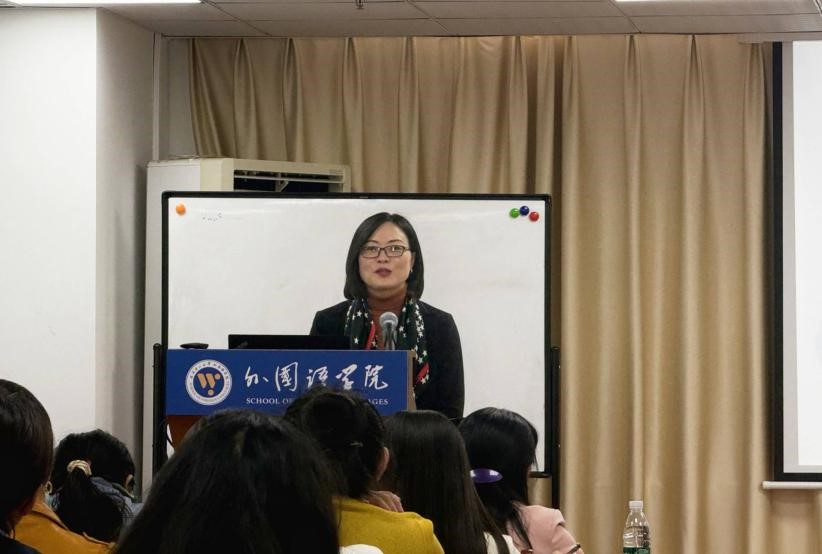
Professor Chen Wei then introduced Professor Huang Qin in detail. Professor Huang is a renowned professor, Ph.D. supervisor, and postdoctoral research supervisor at the School of Foreign Languages, Huazhong University of Science and Technology. She concurrently serves as Director of the English Department and Director of the Translation Research Center. She is also an Executive Member of the China Association for Comparative Studies of English and Chinese, a Standing Director of the Hubei Translators Association, and the Vice President of the Wuhan Translators Association. Professor Huang has published over 60 papers in core journals both domestically and internationally, authored several monographs, translations, and Chinese-English dictionaries, and led numerous high-level projects such as the National Social Science Fund Project, the Humanities and Social Sciences Fund Project of the Ministry of Education, and the Hubei Provincial Social Science Project, demonstrating significant academic influence.
Amidst enthusiastic applause, Professor Huang Qin began her lecture. She first mentioned that since the reform and opening-up, China's translation studies have primarily adopted Western translation theories and methods. However, due to the unique characteristics of China's translation research practice and the need for Chinese scholars not to blindly pursue Western translation theories, domestic scholars began exploring indigenous translation theories in the late 1990s. She emphasized that establishing translation theories and discourse systems with Chinese characteristics to guide Chinese translation practice is of great significance to the development of the discipline of translation in China. The research she shared on that day employed the Criticism Theory of Translator Behavior, a theory with Chinese characteristics.

Combining the Trinity Evaluation System of Translator Behavior with the Three Semantic Frameworks of Translation Criticism, Professor Huang compared the translator behaviors of two translators, using Volume One translated by Hao Yuqing and Volume Two translated by Zhangjing of the Legends of the Condor Heroes series. She first explained the relationship between the Trinity Evaluation System of Translator Behavior and the Three Semantic Frameworks of Translation Criticism. Under the semantic framework of "behavior-text perspective" within the "behavioral criticism" semantic framework, she analyzed the comparison of text selection attributions and translation strategy preferences between the two translators. Within the "text-language perspective" and the "text criticism" framework, she focused on the English translation of vernacular language. After selecting some culturally loaded words with Chinese "vernacular" characteristics, such as idioms, colloquialisms, and phrases from Legends of the Condor Heroes, she classified them into five categories: ecological, linguistic, material, social, and religious. Through a series of vivid examples, she detailed the translators’ preferences and differences. She also compared the translators’ behavior in terms of translation completeness and structural aspects. Lastly, within the "behavior-society perspective" and "effect criticism" framework, she examined the social effects of the two translators' behaviors. Throughout the lecture, Professor Huang not only presented fascinating research content but also suggested valuable research directions for the faculty, encouraging everyone to continuously explore and innovate in translation studies.

The interactive session was lively, with Professor Huang patiently answering every question. Her in-depth and insightful answers greatly benefited the faculty and students. After the interaction, Professor Chen Wei provided a wonderful summary and commentary on the lecture, which concluded with warm applause.
The successful hosting of this lecture not only provided a valuable platform for learning and exchange for the faculty and students of the School of Foreign Languages but also offered new ideas and directions for translation research. It is hoped that there will be more such academic exchange opportunities in the future.
(Photos by Chen Yuzhe, Text by Liang Xiaohui, Edited by Liu Si, Reviewed by Li Hui)
Translators: Cui Dongyue, Zheng Baiwei
